“I’ve never written, though I thought I wrote, never loved, though I thought I loved, never done anything but wait outside the closed door.”
– Marguerite Duras, The Lover
There is a moment in love when the floor disappears. Not the dramatic falling of romance novels, but something quieter and more terrifying: the realization that the self has become porous. That boundaries once thought solid have dissolved. That the "I" has become a "we" so completely that the "I" no longer remembers its own edges.
Marguerite Duras captures this fever precisely. In The Lover, the young girl stands on the ferry crossing the Mekong River, wearing the man's fedora, and becomes nothing but the desire for him. She ceases to be a subject with her own history, her own colonial shame, her own becoming. She becomes only the object of his glaze, the surface of his desire, the ghost haunting her own life. The prose itself dissolves into this state--fragmented, hypnotic, dissociative. Reading it feels like watching someone drown in slow motion, except the water is warm and the drowning feels like ecstasy.
“The story of my life doesn’t exist. Does not exist. There’s never any center to it. No path, no line. There are great spaces where you pretend there used to be someone, but it’s not true, there was no one.”
– Simone de Beauvoir, The Second Sex
Duras offers no escape from this. The book simply records the fever, validates the vertigo, shows what it looks like to lose the self completely and find that loss beautiful. It is a dangerous book for those who recognize themselves in it.
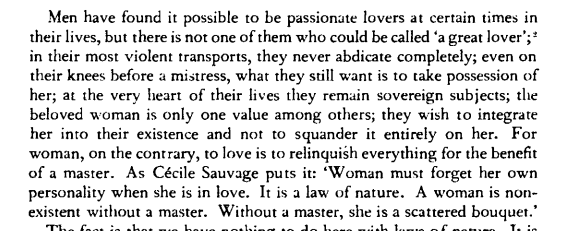
Simone de Beauvoir, in The Second Sex, analyzes the same phenomenon with clinical precision. Where Duras gives the feeling, de Beauvoir gives the anatomy. The woman in love, she argues, makes herself into the absolute other. She ceases to be a subject and becomes only the object of the beloved's consciousness. She disappears into him, not because love requires this, but because she has been taught that love is the only permissible transcendence available to her. She abdicates her freedom, her projects, her self, in order to become the mirror in which he sees himself reflected.
“A woman's situation, i.e those meanings derived from the total context in which she comes to maturity, disposes her to apprehend her body not as instrument of her transcendence, but "an object destined for another."”
De Beauvoir sees this as a fundamental temptation of love--the desire to merge completely, to dissolve the painful separateness of existence into a unity that never existed and never can exist. The beloved becomes the absolute center of the world; his words become scripture; his moods become weather. And slowly, imperceptibly, the self erodes. Not dramatically, not in a single moment of crisis, but in the accumulation of small abdications. The preferences adjusted. The silences kept. The self slowly shaped into something that fits better in the space he provides.
The question becomes: when one recognizes this erosion, what then? The temptation is to frame it as a binary: leave and reclaim the self, or stay and accept the loss. Duras suggests the second option is possible--one can simply remain in the fever until it burns out. De Beauvoir suggests the first is necessary--one must reclaim subjectivity or cease to be fully human.
But there is a third whisper, barely spoken, that haunts the periphery: perhaps it is better to have loved no one and nothing at all but the self. To remain untouched, unentered, unbroken. To keep the self intact, solitary, sovereign. To choose the fortress over the field, the closed fist over the open hand. To never know the fever, nor the anatomy of its loss. To sleep through the night without wondering if another's mood will become weather. To hold the self in both hands, complete, requiring no mirror but the mirror.
Whereas woman, in assuming her role as the inessential, accepting a total dependence, creates a hell for herself. Every woman in love recognizes herself in Hans Andersen's little mermaid who exchanged her fishtail for feminine legs through love and then found herself walking on needles and live coals.