Isaiah 55:8-9
"For my thoughts are not your thoughts, neither are your ways my ways," declares the Lord. "As the heavens are higher than the earth, so are my ways higher than your ways and my thoughts than your thoughts."
There is a space between the human and the infinite. A gap. A distance measured not in miles but in categories. Isaiah names it first: the divine is not simply a stronger version of the human, not merely a wiser or more powerful entity operating within the same logic. God's thoughts are not our thoughts--not just different, but belonging to an entirely different order of being. The heavens are higher than the earth not by degree but by kind.
Three texts circle this same wound: the prophet Isaiah, Albert Camus in The Rebel, and Søren Kierkegaard in Fear and Trembling. Each wrestles with the vertigo of standing at the edge of human comprehension, staring into a silence that refuses to resolve into meaning.
The Absurd Rebellion
Camus begins where Isaiah ends--with the recognition that the universe does not conform to human demands for justice, meaning, or rational order. In The Rebel, he describes the "absurd" as the confrontation between human need for clarity and the silent, irrational world. The rebel, Camus says, refuses both the denial of this gap (religious consolation) and the acceptance of nihilism (giving up on meaning).
But Camus's rebel stands in an inverted relationship to Isaiah's prophet—and to Abraham. Where Isaiah says "God's ways are higher," Camus says "the universe has no ways at all"--it is indifferent, mechanical, silent. Yet both agree on the fundamental premise: human reason cannot cross the distance. The rebel, like the prophet, acknowledges that the "metaphysical hunger" of humanity will not be satisfied by the world as it is.
The crucial difference: Isaiah suggests there is meaning on the other side of the gap, even if we cannot access it. Camus insists the gap is ontological--the silence is not hiding wisdom; it is simply silence. Abraham, faced with the command to sacrifice Isaac, would later represent the opposite impulse: where the rebel refuses the absurd by saying no, Abraham obeys the voice within the silence by saying yes. The rebel preserves his integrity through defiance; Abraham risks everything through submission.
Yet both demand that we live with eyes open to the distance. Isaiah warns against thinking God's plans are merely human plans scaled up. Camus warns against thinking the universe owes us justice. Both are guarding against anthropomorphic comfort. The rebel fills the silence with human solidarity and defiant meaning-making, refusing to kneel before what he cannot understand. Abraham, in contrast, leaves the silence empty, trusting that the God who commands the unthinkable will also provide the lamb.
The Teleological Submission
If Camus's rebel stands defiant before the gap, Kierkegaard's Abraham kneels. Fear and Trembling presents the terrifying counter-image to the rebel: not "I rebel, therefore we exist," but "I obey, therefore I am." Where the rebel refuses the silence, Abraham listens to the voice within it.
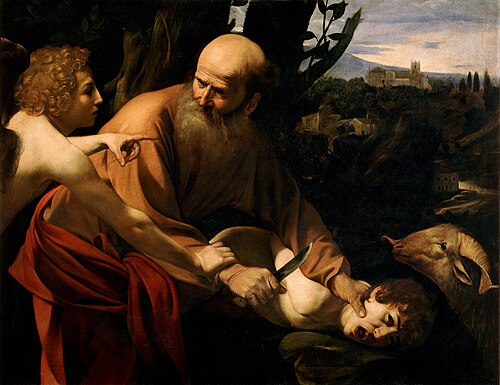
Isaiah's verse becomes the justification for the unthinkable: if God's ways are higher--not just morally superior but categorically different--then what happens when God's command violates human ethics? Abraham stands at Mount Moriah holding the knife over Isaac, and Kierkegaard asks: is there a "teleological suspension of the ethical"?
Here the gap becomes a chasm over which one must leap not in defiance, but in submission. The knight of faith does not demand explanation. He does not calculate. He does not rebel against the ethical universal (thou shalt not kill) by asserting his own will--he suspends it in obedience to the higher. Abraham cannot understand why he must sacrifice Isaac. Reason breaks. Ethics break. But he raises the knife anyway.
Kierkegaard distinguishes the "knight of infinite resignation" (who accepts the gap like Camus, nobly choosing the universal ethical) from the "knight of faith" (who makes the leap into the paradox of obedience). The infinite resignation is the rebel's position: accepting that the finite and infinite do not meet, choosing to live within the absurd while preserving human dignity and ethical consistency. But faith, Kierkegaard says, believes that with God all things are possible--that the individual can stand in absolute relation to the absolute, even when that relation demands the sacrifice of the universal.
Camus's rebel says no to the absurd. Abraham says yes to the voice. Both face the same silence, the same gap between human thought and the infinite. But where the rebel fills the silence with human solidarity and defiant meaning-making, Abraham leaves it empty, trusting that the God who
commands the unthinkable will also provide the lamb. He submits to the higher, even when--especially when--it appears as the absurd.
The Three Positions at The Gap
| Feature | Isaiah (The Prophet) | Camus (The Rebel) | Kierkegaard (The Knight of Faith) |
| Nature of the Gap | Divine Transcendence | The Absurd Silence | The Paradoxical Chasm |
| Human Response | Humble Reception/Grace | Defiant Meaning-Making | Absolute Submission |
| View of Reason | Reason is limited | Reason is the only tool | Reason must be sacrificed |
| Core | "Thy will be done" | "I rebel, therefore we exist" | "By virtue of the absurd" |
Isaiah establishes the premise: there is a radical transcendence. Human thought and divine thought operate at different altitudes.
Camus responds: if we cannot know the divine (or if the divine is silent), then we must create meaning through rebellion. We must demand justice despite the universe's indifference, knowing our demand will never be fully met. The gap remains; we fill it with human solidarity rather than divine consolation. The rebel preserves his integrity by refusing to submit to what he cannot understand.
Kierkegaard responds: the gap is real, and it demands not rebellion but faith. By the individual's absolute submission to the absolute. Abraham does not rebel against the ethical--he suspends it, believing that the God who commands the sacrifice will also be the God who provides. He obeys without understanding, trusting that with God, the impossible is possible.
Where We Are
Perhaps the modern condition is learning to hold all three simultaneously. To recognize with Isaiah that our thoughts are not the highest thoughts. To rebel with Camus against the silence, insisting on meaning even when the universe withholds it. And to risk with Kierkegaard the leap into faith, believing that the gap, however wide, does not separate us from love.
Or perhaps, as Isaiah suggests, the rain and snow come down from heaven not to return empty, but to water the earth. The higher ways do not stay higher; they descend. They become bread. The gap is bridged not by our climbing up, but by grace coming down.
And yet--the heavens remain higher than the earth. The mystery remains. The distance is never fully closed. We stand, like Abraham with the knife, like the rebel facing the executioner, like Isaiah before the vision of the holy, knowing that the most important truths are the ones we cannot think, only live.