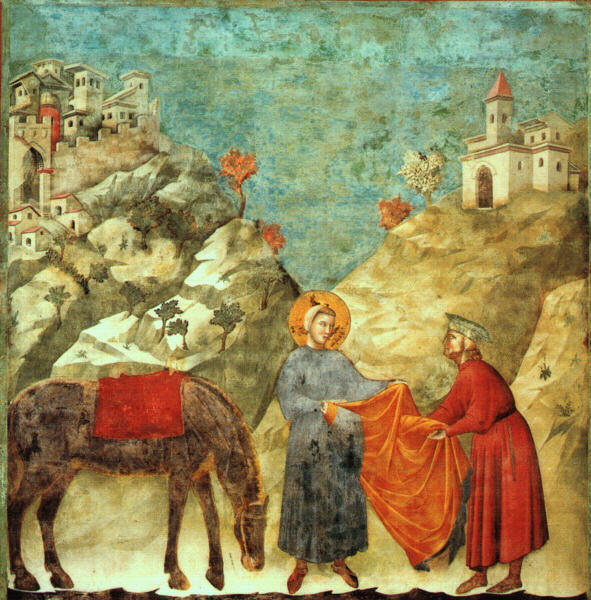
Matthew 25:40 states: "And the King will answer them, ‘Truly, I say to you, as you did it to one of the least of these my brothers, you did it to me’
The setting
This verse sits at the climax of the “parable of the sheep and the goats” — the final judgment scene where Jesus separates humanity into two groups. The sheep (righteous) Are on his right, goats (unrighteous) On his left. The criteria for separation isn’t doctrine, ritual purity, or religious affiliation. It’s one question: What did you do to the vulnerable?
The King lists six categories of need: Hungry, thirsty, stranger, naked, sick, imprisoned. The sheep are baffled -- “when did we see you hungry and feed you?” the King answers with verse 40.
“and the King will answer them”
The speaker is identified as King -- not teacher, not shepherd, not friend. This is royal authority speaking, but it’s crucial that this King’s authority is defined by solidarity with the powerless, not dominance over them. The “them” here are the sheep, the righteous, who are confused by their own inclusion.
“truly, I say to you”
Amen lego humin — the Greek amen is transliterated Hebrew. Jesus uses this phrase when he’s about to drop something that upends normal categories. It’s not just “I’m telling the truth” -- it’s “pay attention, reality is about to be redefined.”
“as you did it to one of the least of these”
“henos ton elachiston” — “one of the least.”
Elachistos is superlative: Smallest, youngest, least important. In a society obsessed with honor and hierarchy, these are the people who Don’t register. The ones you look past. The ones who can’t repay you, can’t elevate your social status, can’t network back. They are, by definition, those the world considers worthless.
“my brothers”
This is where theologians fight. Who are these "my brothers”?
View 1: Jesus refers specifically to his disciples -- those who preach the gospel and suffer for it. The “least” are persecuted missionaries, and caring for them is proxy for caring for Christ’s mission.
View 2: Jesus refers to all suffering humanity. The “brothers” is an expansion of kinship -- anyone in need becomes family to Jesus.
Either way, the identification is radical. Jesus isn’t saying “they represent me” or “they remind me of me.” He’s saying something ontological[1]: In the suffering other, there is a mysterious presence of Christ himself.
“you did it to me”
Emoi epoiesate — “to me you did.”
This is the theological earthquake. The creator of the universe has hidden himself inside the suffering of the marginalized. When you feed the hungry, you feed God. When you visit the prisoner, you visit God. When you welcome the brothers and sisters in need, you welcome God. When you clothe the naked, you cover the shame of God.
This changes everything. The person begging at the intersection isn’t an obstacle to your destination -- they are your destination. The prisoner isn’t a statistic to be managed, but a Christ to be encountered.
The implications
- Christology of vulnerability: God is not found primarily in power, beauty, or success, but in brokenness. The incarnation isn’t just Christmas -- it’s every hungry belly, every stranger at the border, every sick body lying on a sidewalk.
- Judgment criteria: Salvation isn’t measured by what you believe about Jesus, but what you do to Jesus disguised as the poor. James 2 Faith without works dies here -- but more than that, works are the Faith. The orthopraxy[2] is the orthodoxy[3].
- The shock of the sheep: Notice the righteous didn’t know they were doing this. They weren’t calculating “if I feed this homeless person, I score points with God.” Their righteousness was unconscious, natural, unperformed. The goats, meanwhile, seem indignant -- “when did we see you hungry and not feed you?” They probably thought they were religious enough.
- Solidarity as sacrament: This verse essentially sacramentalizes charity. Baptism and Eucharist matter, but so does the cup of cold water. The mundane act of human decency becomes an encounter with the divine.
The uncomfortable part
This verse is terrifying because it removes religious loopholes. You can't say "I love Jesus" while stepping over Him sleeping on the street. You can't claim personal relationship with Christ while voting to cut food stamps. The "least" are the litmus test of whether you actually see Christ at all.
And the "one of" -- henos -- is specific. Jesus doesn't say "as you did to the poor in general" or "as you supported systemic change." Those matter. But this is granular: one person. One meal. One visit. The revolution happens at the level of individual encounter.
The visibility problem
Matthew 25:40 establishes the principle: God is present in the vulnerable. But 1 John 4:20 exposes the cognitive dissonance we use to avoid this. "Whoever claims to love God yet hates a brother or sister is a liar. For whoever does not love their brother and sister, whom they have seen, cannot love God, whom they have not seen."
The logic is devastating in its simplicity. We construct elaborate theologies about loving the invisible -- God, heaven, salvation -- but flinch from the visible. The stranger at the border becomes abstract. The war victim on the news becomes statistics. We retain our piety toward the unseen while hardening ourselves against the seen.
But John's epistle won't allow this divergence. Agape[4] (ἀγάπη) isn’t a private transaction between soul and deity; It’s a public demonstration toward neighbor. And notice the familial language: Brother and sister. Not “fellow citizen.” not “documented resident.” The early church broke down the ethnos barrier specifically to claim that kinship in Christ transcends blood and border.
Matthew gives us the ontology -- Christ is there, in the detention center, in the raft crossing open water, in the body sleeping on the pavement. John gives us the epistemology[5] -- if you can’t love what you can see, your claim on the invisible is fraudulent.
Agape (ἀγάπη)
When I said "agape isn't a private conversation between soul and deity," I meant: this kind of love can't stay in your head or your prayer life. It's not about having warm feelings towards God while ignoring people.
John is saying: if you claim to love God (the invisible) but hate your brother (the visible), you're lying. Because agape -- the real, divine, self-giving love -- always moves outward. It can't be contained in a vertical relationship (you-and-god) without spilling into horizontal relationships (you-and-neighbor).
Jesus in Matthew 25 isn't asking "did you feel religious?" he's asking "did you feed the hungry?" agape is love that becomes food, water, clothing, visitation -- tangible action toward tangible people.
Footnotes
1. Ontology is the branch of philosophy studying the nature of being, existence, and reality.
2. Orthopraxy means "correct practice" or "right action" (derived from Greek orthos, meaning straight/right, and praxis, meaning action/practice).
3. Orthodoxy, derived from Greek for "right belief" or "right glory," signifies strict adherence to accepted, traditional, or authorized doctrines, primarily in religion.
4. Agape (ἀγάπη) is an Ancient Greek word referring to the highest form of love: unconditional, selfless, and sacrificial love.
5. the theory of knowledge, especially with regard to its methods, validity, and scope. Epistemology is the investigation of what distinguishes justified belief from opinion.