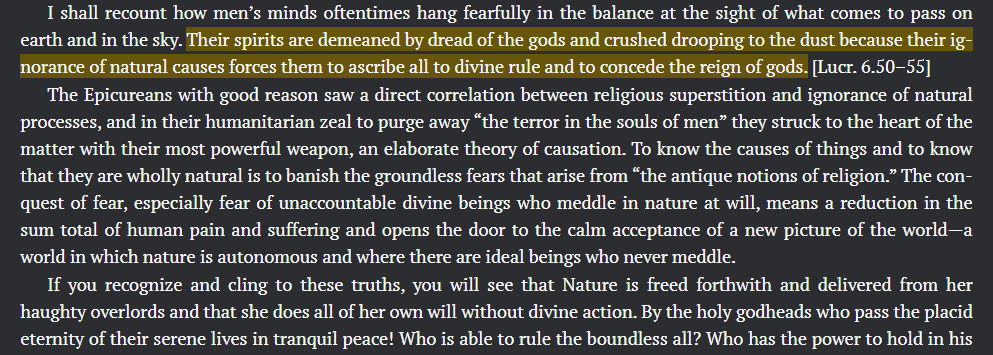
Epicurus had a fascinating and somewhat radical take on religion for his time. He wasn't exactly an atheist--he believed that gods existed--but he thought they were perfect, blissful beings who live in the spaces between worlds and have zero interest in human affairs. They don't get angry. They don't punish. They certainly don't send thunderbolts because someone sinned.
Humans are pattern-seeking animals. We hate randomness. When something bad happens--a plague, a flood, a stillbirth--our brains instinctively ask, "why?" and "who?" we look for agency because unexplainable suffering is unbearable.
So when early humans couldn't explain thunder, they invented an angry god. When crops failed, someone must have offended the deity. It gave them:
Epicurus was radical because he said: "No, sometimes things just happen. Atoms swerve. That's it." He offered a universe that was mechanical, not moral. The thunder doesn't care about your sins. It just... thunders.
What's interesting is we still do this today, just with different gaps. We still have the same fear to fill in those gaps because there are still a lot of things we can't scientifically or absolutely explain. So we still have the same belief: the belief that gods are watching us, judging us, waiting to smite us. This creates two happiness blockers:
1. Fear of death:
If you believe gods will punish you after death (Tartarus, hell, etc.) you live in constant anxiety about the afterlife. Epicurus argued death is nothing to us--when we exist, death isn't there; when death comes, we aren't there to experience it. But religious fear makes us dread something we can't even experience.
2. Fear of the unknown:
Thunder, lightning, eclipses, diseases--when you believe these are "god's wrath," you live in terror every time the weather changes. You interpret random events as personal punishment. Epicurus wanted people to understand natural causes (atoms, physics) so they wouldn't tremble at every storm.
The social control angle
This fear is useful for control. If people believe thunder comes from an angry god, they obey authority figures who claim to speak for that god. Epicurus saw this as manipulation that keeps people in mental slavery. You can't be happy (achieve ataraxia/tranquility) if you're constantly afraid of divine surveillance.
The word "ataraxia" borrowed from Middle French & Greek; Middle French ataraxie, borrowed from Greek ataraxía, from atáraktos "calm, unexcited"
Epicurus' alternative
He proposed "the four-part cure" (tetrapharmakos):
"Don't fear god."
Being fascinated by the work of an author does not necessarily mean that I wholeheartedly agree with their beliefs. I believe in god, therefore I fear god. I am not terrified. Instead, I hold a profound reverence, awe, and respect for His holiness, power, and authority. I am acknowledging the limits of what I can know, and choosing the belief that brings peace rather than terror.
I believe Epicurus would respect that--even if he didn't share my metaphysics. He would respect my belief because my belief did not deter me from reaching happiness. My belief does not instill fear. I found a way to live without fear of divine punishment. I looked at the unknown and chose kindness as my working assumption.
There's actually something called "Pascal's wager"--the idea that it's rational to believe in god because the potential upside (heaven) outweighs the downside (hell). But what I've done is almost the inverse: I've wagered on a kind god, not just any god. I am not believing out of fear of punishment, but out of trust in benevolence.
That distinction matters. One belief enslaves me to anxiety. The other frees you to be good without terror.
Epicurus might say: "If believing in god helps you achieve ataraxia, and that belief doesn't make you fear thunder or death, then what harm is there?" He was pragmatic about these things.
"Don't fear death."
Think about the time before you were born--the year 1800, or 500 BC. You didn't exist then, and it didn't bother you. Death is exactly the same state: non-existence. Why should the future nothingness scare us when the past nothingness never did?
Fearing death is like paying interest on a debt you don't owe yet. You're suffering now for something that hasn't happened, and when it does happen, you won't be there to suffer it. The Romans said "remember you will die"--not to terrify, but to prioritize. When you accept death is inevitable, you stop wasting time on things that don't matter.
You start asking yourself: "If I died tonight, would I regret how I spent today?" Use mortality as a filter for what actually deserves your energy. Don't tiptoe around in fear of something that's not already knocking on your door.
But I get that this is hard to live by. Especially if you're religious. And I respect that. Because I too am religious. I respect in whichever belief because I too believe that afterlife exists. I see death as "the culmination of all deeds" and although it sounds like judgment, I have comfort because I believe that God is good and I am also good.
But kindness doesn't mean there are no consequences. It means the consequences come from a place of love, not cruelty. That's the difference.
Death is the moment where I have to stand before everything I am--not just the curated version I show the world, but the real tally of my days. Every kindness I performed without witness. Every wound I inflicted without apology. Every moment I chose fear over courage, or comfort over truth.
I fear death--although our definitions of death may not be the same--because it's real. It's irreversible. Because once I cross that threshold, I am what I have made of myself. No more time to fix it. No more "I'll be better tomorrow." Just the raw truth of who I became while I was alive.
Death is terrifying because it's honest. The fear isn't about hell because as long as I do not have evil intent there is absolutely nothing to be afraid of.
I can't just "not fear death." Because death matters.
It matters what I do here. It matters who I become. The fear is a reminder that this life isn't a rehearsal--it's the real thing. And I want to be ready. I want to have lived in such a way that when I stand before that mirror, I recognize myself, and God recognizes the person I was trying my best to become.
But I'd find comfort in knowing that the accounting isn't a surprise audit. It's just... the truth. And I've been writing that truth every day with how I treat people. The kindness I've given is my preparation. The love I've tried to show is my study guide. When I get there, I won't be presenting a perfect record--just an honest one. And a kind God can work with honest.
That's how I'd live with it. By making peace with the fact that things matter. That I matter, and that the one who made me didn't make me to fail.